
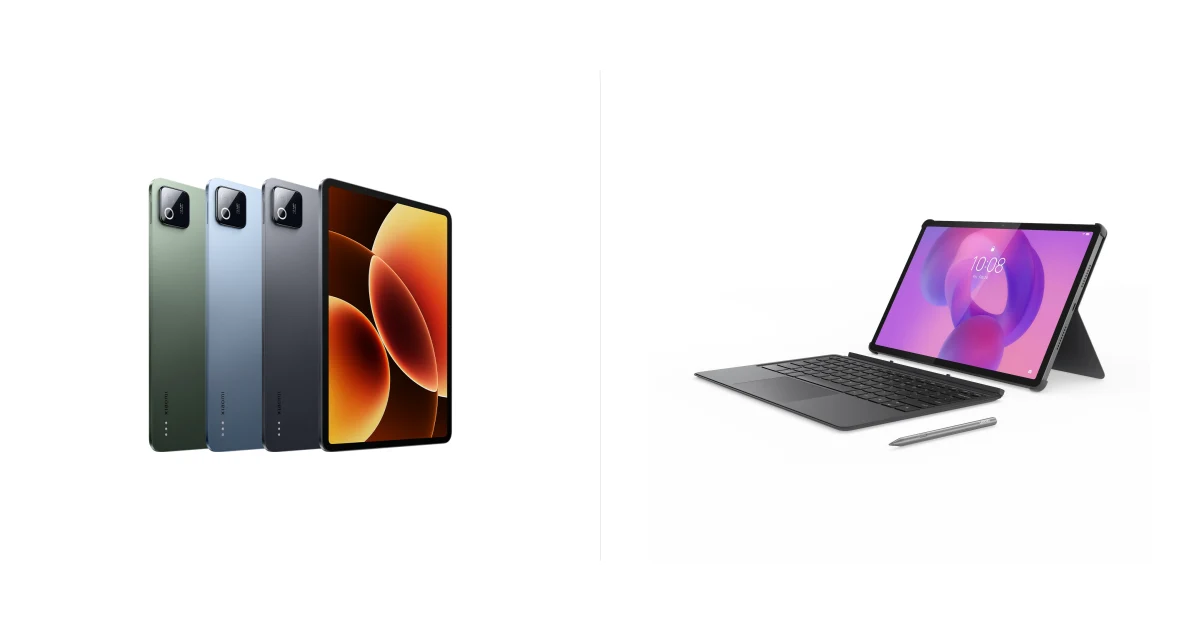
Both have 144 Hz screens. The Xiaomi is cheaper and faster, the Lenovo bigger.
Short answer
Xiaomi Pad 8 - Snapdragon 8s Gen 4, 11.2" 3200×2136, 5.75 mm and 485 g, cheaper. Lenovo Idea Tab Pro - 12.7" 2944×1840, 10,200 mAh.
Key differences
| Spec | Xiaomi Pad 8 Wi-Fi | Lenovo Idea Tab Pro Wi-Fi |
|---|---|---|
| Chip | Qualcomm Snapdragon 8s Gen 4 | MediaTek Dimensity 8300 |
| Display | 11.2", LCD, 3200×2136, 144 Hz | 12.7", IPS LCD, 2944×1840, 144 Hz |
| RAM / storage | 8/128 GB, 8/256 GB, 12/512 GB | 8/128 GB, 8/256 GB, 12/256 GB |
| Rear cameras | 13 MP | 13 MP |
| Front | 8 MP | 8 MP |
| Battery | 9200 mAh | 10200 mAh |
| Charging | 45 W | 45 W |
| Stylus | Xiaomi Focus Pen | Lenovo Tab Pen Plus |
| Connectivity | Wi-Fi | Wi-Fi |
| Speakers | 4 | 4 |
| Thickness / weight | 5.75 mm / 485 g | 6.9 mm / 620 g |
| Price | current prices | current prices |
Specs come from the device pages on Smartphone.ua.
Chips
Qualcomm Snapdragon 8s Gen 4 and MediaTek Dimensity 8300. The 8s Gen 4 is faster.
Display
11.2" 3200×2136 vs 12.7" 2944×1840, both 144 Hz.
Battery
9200 vs 10,200 mAh, both 45 W.
Verdict: who should buy which
- Speed, compactness, price - Xiaomi Pad 8.
- A big screen - Lenovo Idea Tab Pro.
FAQ
Do both support a stylus?
Yes: Xiaomi Focus Pen and Lenovo Tab Pen Plus.
How heavy is the Lenovo?
620 g.
Which is cheaper?
The Xiaomi Pad 8.