
IP68 and IP69: what water and dust protection ratings mean
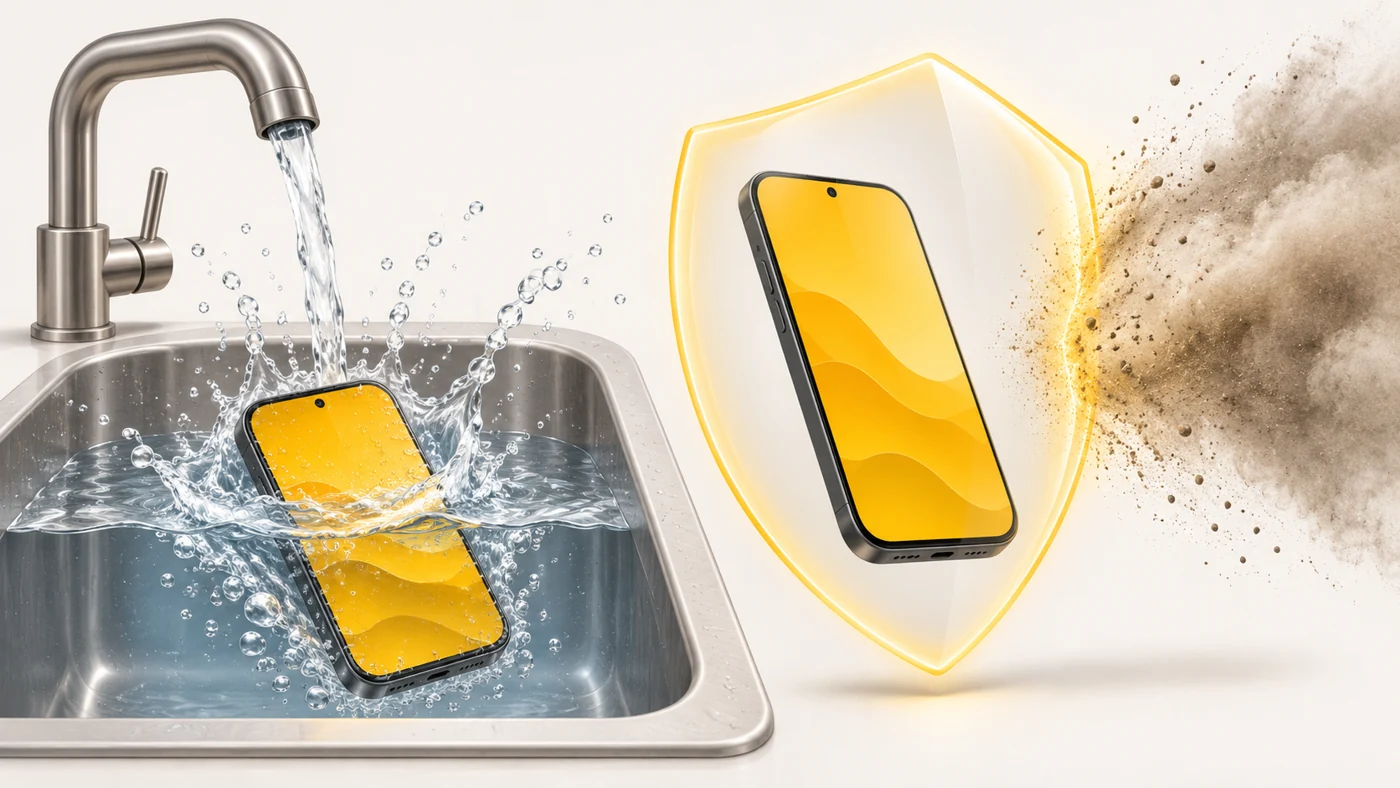
IP68, IP69 and other IP (Ingress Protection) codes are an international way of showing how well a device's body is protected against dust and water. The first digit is dust protection, the second is water protection.
In plain words
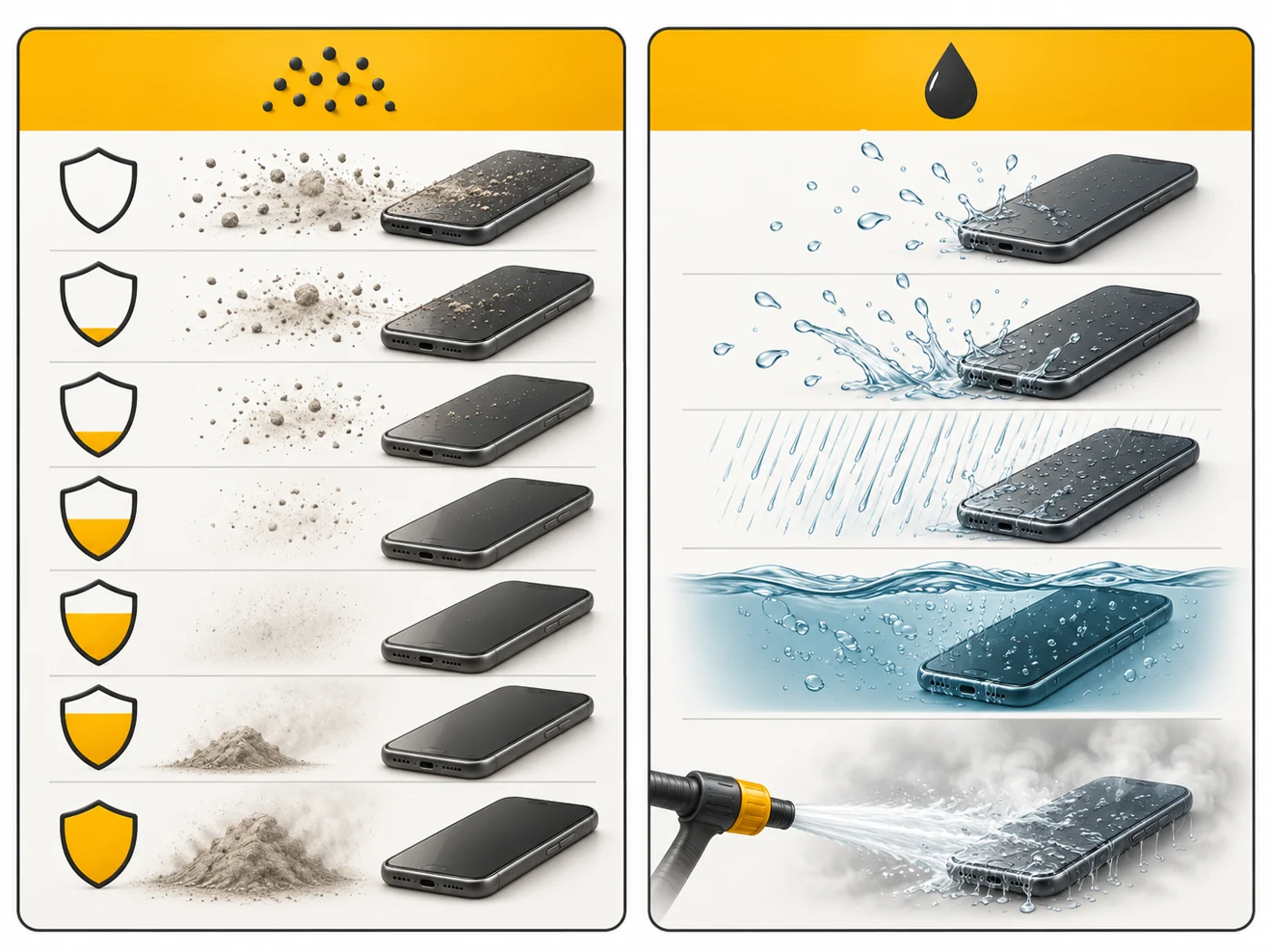
Think of marks in a school report for two subjects. The first digit is the "dust mark" from 0 to 6, where 6 means no dust gets in at all. The second is the "water mark" from 0 to 9: 4 is splashes, 7 is brief immersion, 8 is longer immersion, and 9 is a jet of hot water under pressure. If there's an X instead of a digit, like IPX4, that "subject" simply wasn't tested.
How it works
- The device is tested in a lab according to the IEC 60529 standard.
- For dust, it's kept in a chamber with fine dust to see if any gets inside.
- For water, it's splashed, submerged or sprayed with a jet, depending on the level.
- For IP68 the manufacturer sets the conditions: for example, 1.5 m of fresh water for 30 minutes.
- IP69 is a test with hot high-pressure jets, like at a car wash.
Where you'll see it
IP ratings appear in the specs of smartphones, tablets, watches, earbuds and rugged phones. In our comparisons it's the "Protection" row. Many rugged phones have both IP68 and IP69, plus the military MIL-STD-810H standard.
Does it matter when buying
Yes, but know the limits. IP68 will save your phone if it falls into a puddle or sink or you get caught in a downpour. Pools, the sea and the beach are riskier: salt and chlorinated water, waves and sand aren't lab conditions. Seals also wear out over the years, and protection can be lost after a drop or a repair. That's why most manufacturers don't cover water damage under warranty.
Myths
- Myth: With IP68 you can shoot underwater in the sea. Reality: Tests are done in fresh water. Salt and chlorine can damage seals and ports.
- Myth: IP69 is better than IP68 in every way. Reality: It's a different test - for hot, pressurised jets. Some devices have both ratings because one doesn't replace the other.
FAQ
What does IPX4 mean?
Protection against splashes from any direction. Dust wasn't tested.
How is IP68 different from 5 ATM on a watch?
ATM is a separate system for watches, aimed at swimming and pressure. 5 ATM is fine for a pool, IP68 isn't always.
Can I charge my phone if the port is wet?
No. Dry it first - many phones warn you about moisture in the port.
Related terms
Water resistance (ATM and EN13319), MIL-STD-810H, Cover glass (Gorilla Glass Victus, Armor), Smartphone