
Reasoning models: when AI "thinks" before it answers
A reasoning model is a language model that, before its final answer, generates a chain of intermediate steps: it breaks down the problem, checks options and corrects itself. This makes it more accurate on hard tasks.
In plain words
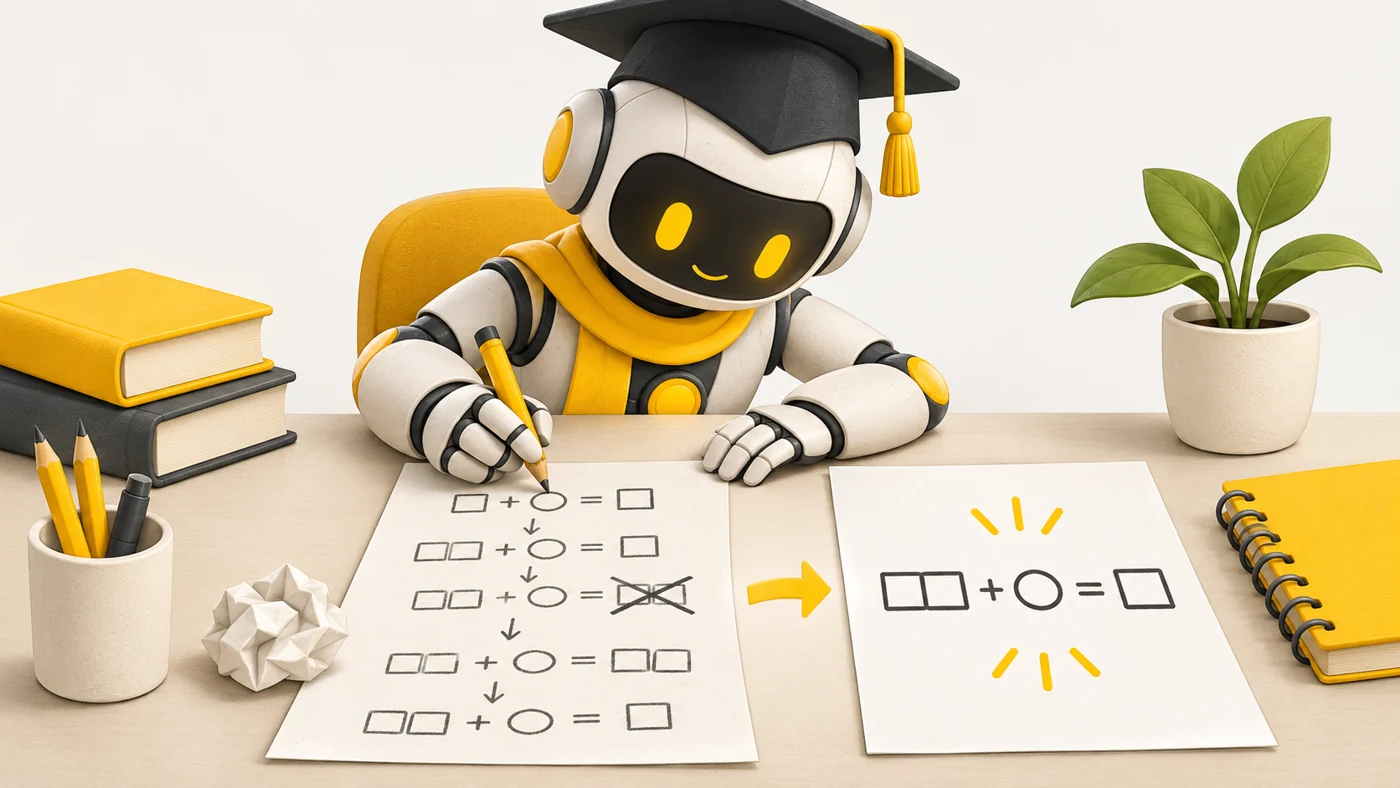
Remember how your maths teacher wanted not just the answer but the full working, step by step? When you write every step, you are less likely to make a mistake. A regular model answers "off the top of its head", while a reasoning model first works it out on scrap paper - and only then writes the clean answer.
How it works
- The model gets a task and does not rush to answer.
- It generates internal reasoning: what is known, what needs to be found, which approaches exist.
- It checks intermediate results and backtracks if it finds a mistake.
- This costs extra tokens and time - from seconds to several minutes.
- You see the final answer and sometimes a short summary of the reasoning.

Where you'll see it
In chatbots these modes are often called "Think", "Thinking", "Reasoning" or "Deep reasoning". They are used for maths, programming, science questions, complex planning and document analysis.
Does it matter when buying
For quick questions - "what is the capital", "rewrite this sentence" - turning on reasoning makes no sense: it is slow and often paid. But for a physics problem, hunting a bug in code or a project plan, this is exactly the mode I use - there are noticeably fewer mistakes. It is not flawless either, though.
Myths
- Myth: The model really thinks like a person. Reality: It is a metaphor. It generates intermediate text that helps it reach a better answer.
- Myth: Longer reasoning always means a more correct answer. Reality: Not always. A model can confidently follow the wrong path for a long time.
FAQ
Why does a reasoning model take so long to answer?
Because it first generates hundreds or thousands of reasoning tokens.
Can I see its "scrap paper"?
Some services show a short summary of the reasoning; the full text is often hidden.
Should I turn on reasoning for homework?
For maths and physics, yes - but work through the solution yourself instead of just copying it.