
SMS: short text messages that still matter
SMS (Short Message Service) is the short text messaging service on mobile networks. One SMS holds up to 160 standard characters, or 70 if it contains emoji, many accented letters or non-Latin alphabets. SMS works without mobile data.

In plain words
An SMS is like a note passed around at break time: short, simple, and it gets through even when the "big hall" (the internet) is closed. That is why banks and services still send codes by text, and why people text each other when the internet is down.
How it works
- The message goes to the operator's SMS centre.
- The centre stores it and delivers it when the recipient is on the network.
- Long messages are split into several SMS.
- Emoji and special characters take more space, so the limit drops.
- SMS needs no internet - only the mobile network.
Where you'll see it
The Messages app on every phone. Banks use SMS for codes, as do delivery services, operators and government services; people also use it to stay in touch where there is no mobile data.
Does it matter when buying
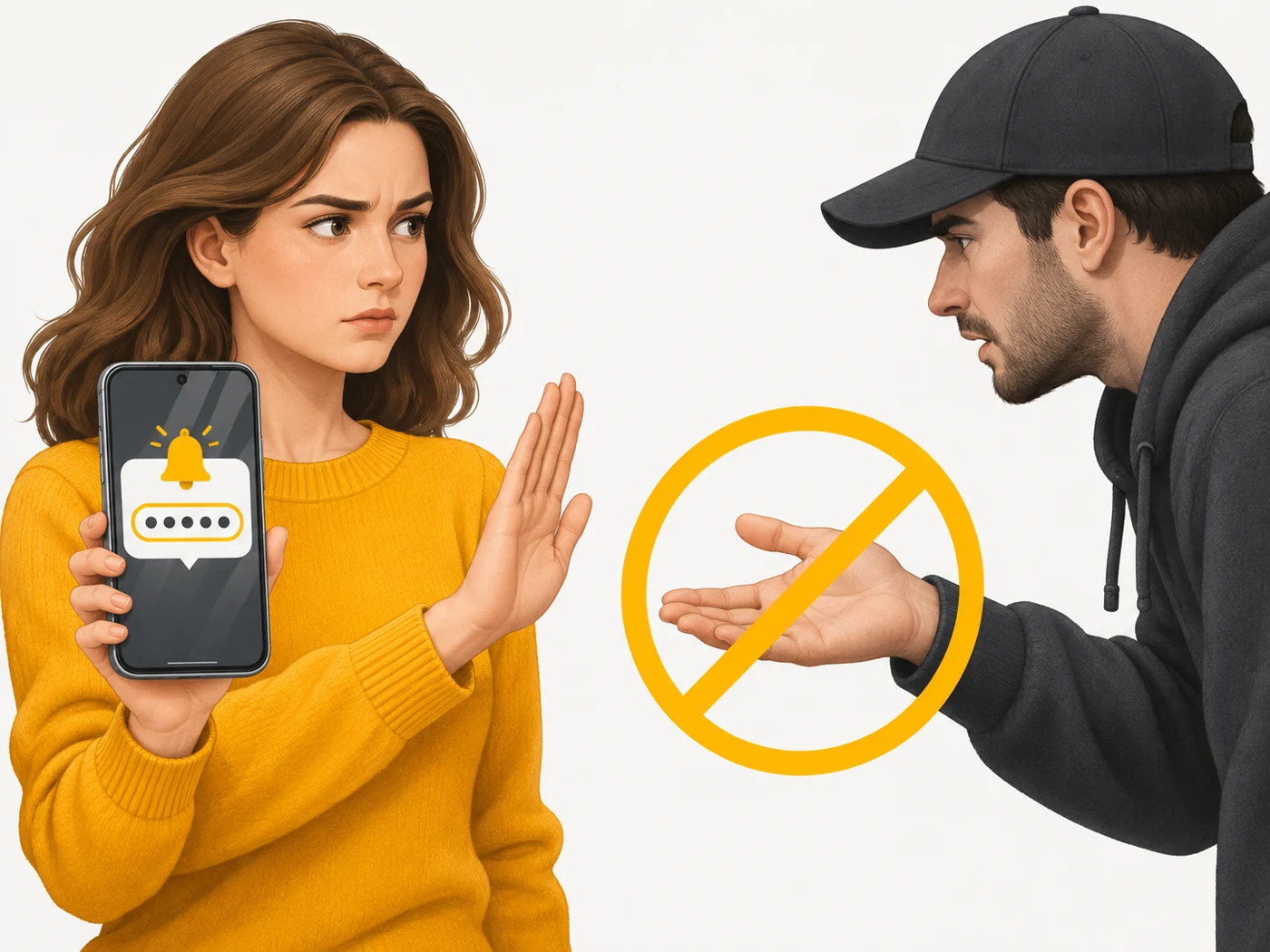
The key thing is security: never share codes from text messages with anyone, even "bank staff". And set a PIN on your SIM so a thief cannot receive your texts in another phone. For important accounts, an authenticator app is better than an SMS code.
Myths
- Myth: SMS is outdated and nobody uses it. Reality: Banks, services and emergency services still use SMS on a huge scale.
- Myth: SMS codes are the most reliable protection. Reality: Texts can be intercepted through SIM swapping; authenticator apps are more secure.
FAQ
Why do texts arrive late?
Because of network load or a weak signal.
Are text messages encrypted?
No, there is no proper encryption.
How many characters fit in an SMS?
160 standard characters, or 70 with emoji or special characters.
Related terms
MMS and RCS, Phishing, Two-factor authentication (2FA), PIN code