
Solar charging watches: how many days the sun adds
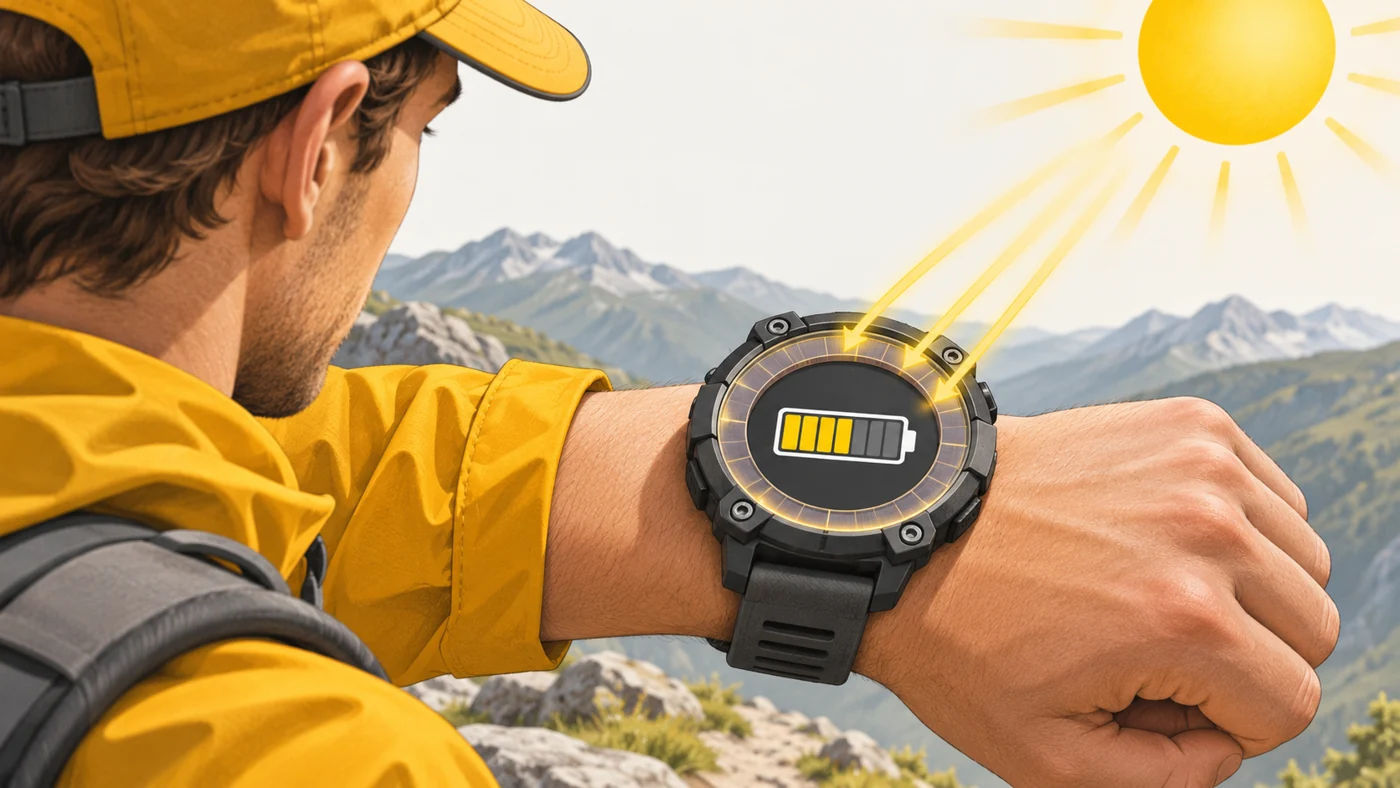
Solar charging on a watch is a built-in transparent solar panel (usually in the glass or around the edge of the dial) that tops up the battery from light and extends the time between charges.
In plain words
A solar panel in a watch is not like a power station but like a small vegetable patch on a balcony: you cannot live off it, but a few fresh tomatoes a day help stretch your supplies. On a sunny day the watch "snacks" and lasts longer; on a cloudy day it gets almost nothing.
How it works
- A transparent photovoltaic layer is built into the glass or a ring around the screen.
- Light is converted into a small current.
- This current tops up the battery or reduces how fast it drains.
- The brighter the light, the more energy - direct sun works best.
- The watch shows how much energy it has gathered from the sun.

Where you'll see it
Solar charging is found in Garmin watches (Instinct Solar, fenix Solar, Enduro, Forerunner Solar), some Casio G-Shock models, Haylou Solar, Coros and others. In our watch comparisons, "Solar" appears in the model names.
Does it matter when buying
It is useful if you spend a lot of time outdoors: hikers, anglers, runners, military personnel. Manufacturers often list a separate battery life "with solar", which can be several times longer with a few hours of bright sun a day. For an office lifestyle the effect is modest.
Myths
- Myth: A solar watch never needs charging. Reality: Some models in power-saving mode with plenty of sun come close, but most still need charging.
- Myth: Any light charges it equally. Reality: Indoor lighting provides very little energy.
FAQ
How much sun is needed?
Manufacturers usually assume about 3 hours of bright sun a day for the stated battery life.
Does the solar panel affect the screen?
Sometimes the screen is slightly darker or has a ring around the edge.
Does sun through a window charge the watch?
Less than outdoors.
Related terms
MIP display, Water resistance (ATM and EN13319), Dual-band GPS (L1 + L5)