
Benchmark: how to read AnTuTu and Geekbench scores
A benchmark is a test program that gives a device a standard set of tasks and rates its performance with a score. The best known for smartphones are AnTuTu, Geekbench and 3DMark.

In plain words
A benchmark is like a school test for phones: everyone gets the same questions and a mark. It is useful for comparing the "students". But the top scorer in a test is not always the best in real life: some copy answers, some tire quickly, and some are just better at tests than at work.
How it works
- The test runs a set of tasks: computing, graphics, memory work, AI.
- It measures how fast the device completes them.
- The result is turned into a score on a standard scale.
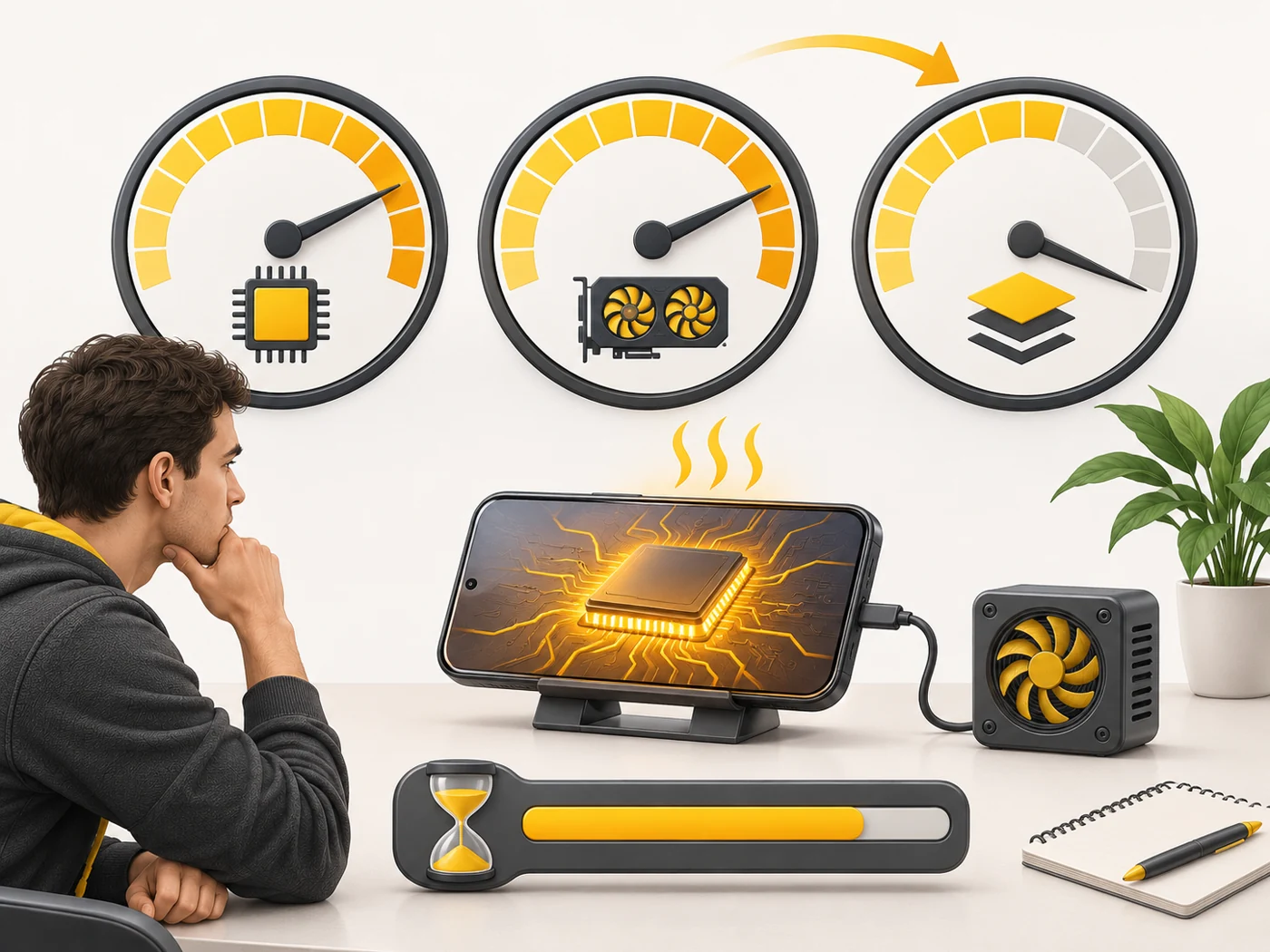
- Geekbench rates single-core and multi-core separately, 3DMark rates graphics, and AnTuTu rates everything together.
- Scores are compared with other devices in the database.
Where you'll see it
Benchmark results appear in reviews, news about new chips and on processor ranking websites. You can also run a test yourself by downloading the app.
Does it matter when buying
As a guide, yes. But I do not recommend choosing a phone on scores alone. First, a 10% difference is unnoticeable in real life. Second, stability (throttling), system optimisation and the camera matter more. Third, there have been cases where manufacturers "tuned" phone behaviour to the tests.
Myths
- Myth: A higher score means a phone is faster at everything. Reality: Scores show peaks. Smoothness of the interface, games and camera also depends on optimisation.
- Myth: Scores from different test versions can be compared. Reality: No, the scale changes with new versions.
FAQ
Which is better - AnTuTu or Geekbench?
They measure different things: AnTuTu is an overall score, Geekbench the CPU, 3DMark graphics. It is best to look at several.
Why is my score lower than in a review?
Because of heat, background apps, power-saving mode or a different test version.
What is a stress test?
Running a test many times in a row to see how performance drops as the device heats up.
Related terms
Thermal throttling, System on a Chip (SoC), Graphics processor (GPU), CPU core architecture (big and little cores)