
Camera sensor size: why 1/1.3" matters more than megapixels
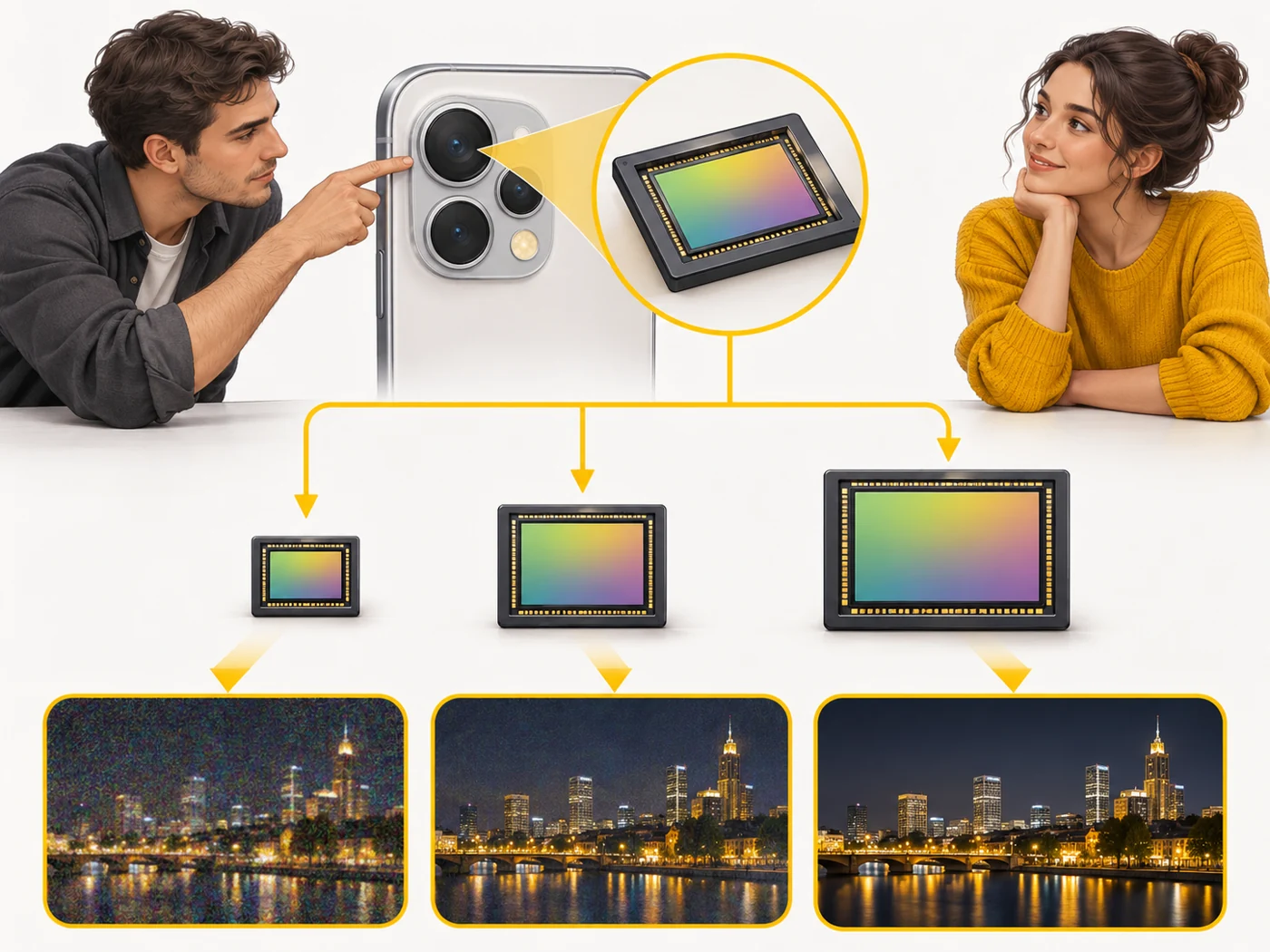
Camera sensor size is the physical size of the light-sensitive chip that captures the image. On smartphones it is written as a fraction of an inch: 1/2.8", 1/1.56", 1/1.3", 1". The closer to 1", the bigger the sensor.
In plain words
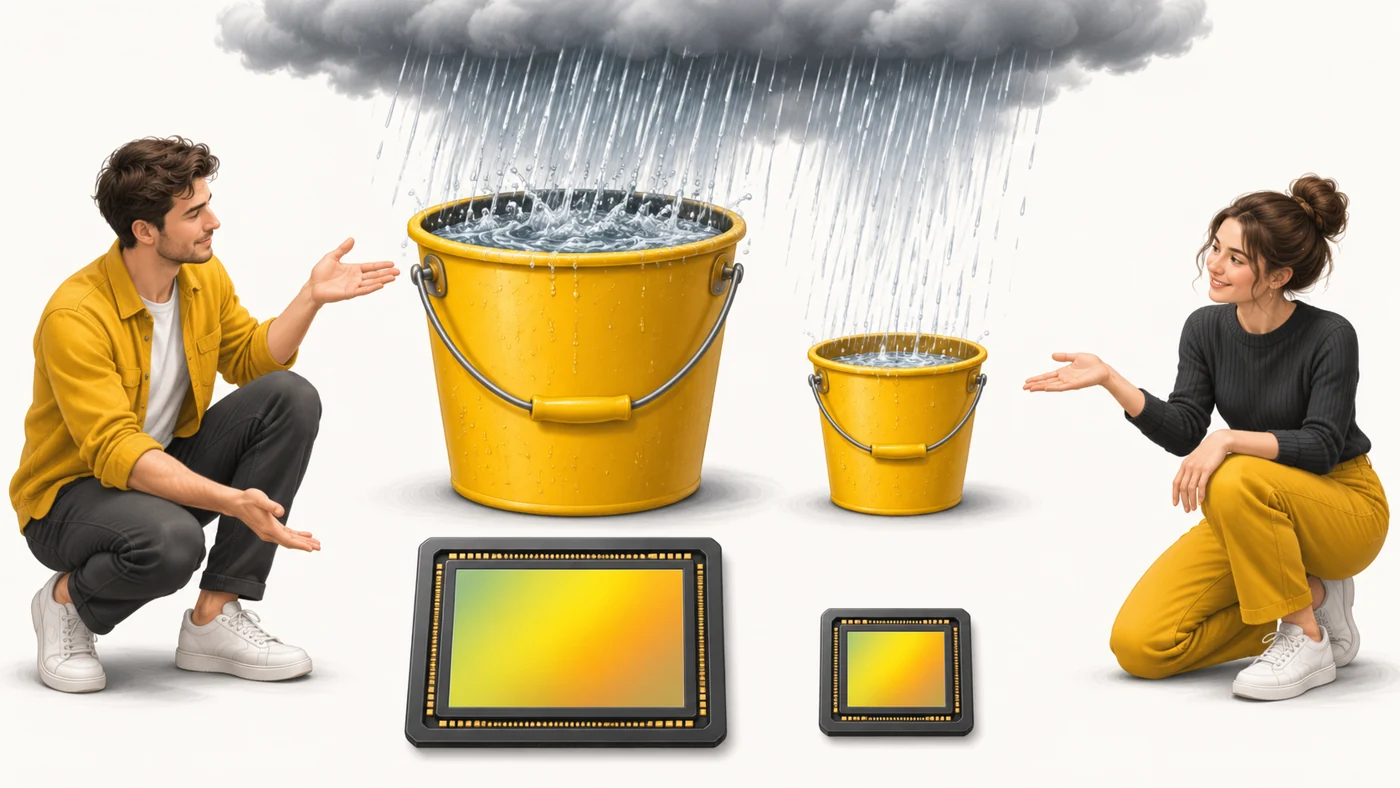
Imagine catching rainwater in buckets. A big bucket collects more water in a minute than a small one. A sensor is a bucket for light. A big sensor catches more light in the same time, so night photos are cleaner and background blur looks more natural. Megapixels are just the number of little cups inside the bucket.
How it works
- The lens focuses light onto the sensor.
- The sensor is made of millions of photodiode pixels that turn light into a signal.
- A bigger sensor with the same pixel count has larger pixels.
- Larger pixels catch more light and produce less noise.
- A big sensor also gives stronger natural background blur.
Where you'll see it
In smartphone camera specs: "50 MP, 1/1.3"" or "1-inch-type sensor". Flagship main cameras use 1/1.3" to 1" sensors, mid-range phones 1/1.56" to 1/1.95", and budget phones smaller ones. The inch labels are a historical convention and do not equal the diagonal.
Does it matter when buying
Yes, especially for night photos and video. I always look at the main camera's sensor size alongside the megapixels. A phone with 50 MP and a 1/1.3" sensor almost always shoots better at night than 200 MP on a small sensor - provided the processing does not let it down.
Myths
- Myth: More megapixels means better photos. Reality: Without a big sensor and good processing, megapixels add little.
- Myth: A 1" sensor has a 2.54 cm diagonal. Reality: No, it is a historical label; the actual diagonal is about 1.6 cm.
FAQ
How do I read 1/1.3"?
The smaller the number under the fraction, the bigger the sensor: 1/1.3" is bigger than 1/1.56".
Does sensor size matter for a telephoto lens?
Yes, especially for zoom in low light.
Why do big sensors make the camera bump stick out?
A big sensor needs a bigger lens, so camera modules have become thicker.
Related terms
Pixel binning, Aperture (f-number), Computational photography, Night mode