
Pixel binning: why a 200 MP camera takes 12 MP photos
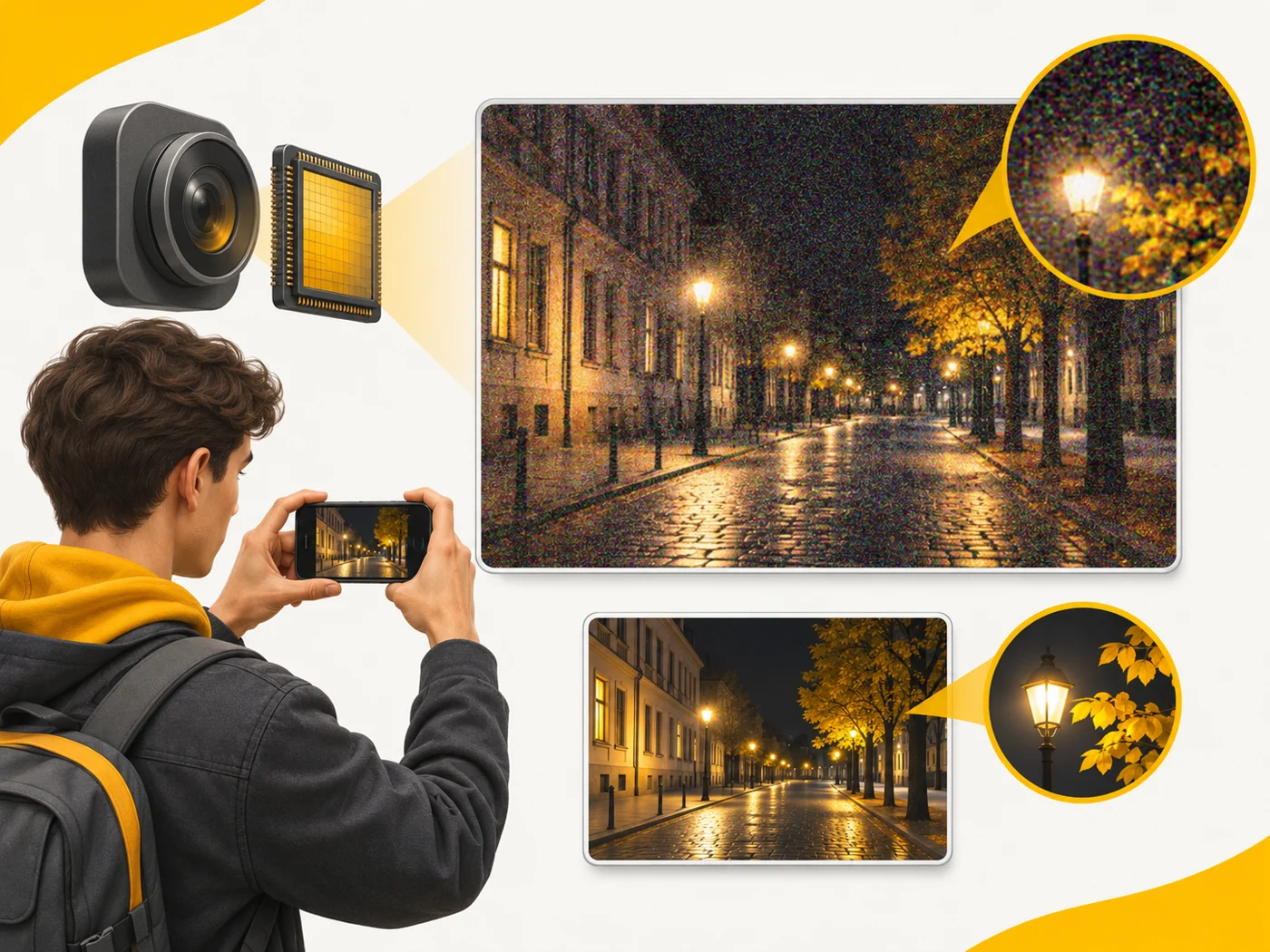
Pixel binning is a technology in which the camera combines the signal from several neighbouring pixels (4, 9 or 16) into one "super pixel". The photo's resolution goes down, but it becomes brighter and less noisy.

In plain words
Imagine collecting rainwater not in one big bucket but in 16 small cups. When the rain is heavy, you can measure each cup separately and get a very detailed picture of where the water fell. When the rain is light, you pour the cups into one bucket so there is enough water to see at all. Binning is "pouring the cups together" in the dark.
How it works
- The sensor has a huge number of tiny pixels - 50, 108 or 200 million.
- Pixels are grouped into blocks with the same colour filter.
- In normal mode, the signal from each block is combined into one - 4-in-1 or 16-in-1.
- The result is a 12-50 MP photo with less noise and better dynamic range.
- In bright light you can switch on full resolution for maximum detail.
Where you'll see it
In almost every smartphone with 48, 50, 108 or 200 MP. By default they save photos at 12 or 50 MP. Full resolution is a separate "50 MP"/"200 MP" mode in the camera app.
Does it matter when buying
Good to know so you are not surprised by your photo size. I only switch on full resolution in good daylight - for example, for a landscape I plan to crop later. Otherwise, the standard binned mode gives better photos and smaller files.
Myths
- Myth: A 200 MP camera always takes 200 MP photos. Reality: By default it almost always combines pixels.
- Myth: Binning is a trick to fool buyers. Reality: It is a compromise: flexibility between daytime detail and a clean image at night.
FAQ
What do 4-in-1 and 16-in-1 mean?
How many neighbouring pixels are combined into one.
Why are full-resolution photos sometimes worse?
At night the tiny pixels are noisy, and processing is slower.
Does full resolution take up a lot of space?
Yes, a single photo can be tens of megabytes.
Related terms
Camera sensor size, Night mode, Computational photography, Image signal processor (ISP)