
Cellular bands: will a phone bought abroad work at home?
Cellular bands are numbered radio frequency ranges used by mobile networks: for example, LTE band 3 (1800 MHz), band 7 (2600 MHz), band 8 (900 MHz) and 5G n78 (3500 MHz). A phone only works on a network if it supports the bands the operator uses.
In plain words
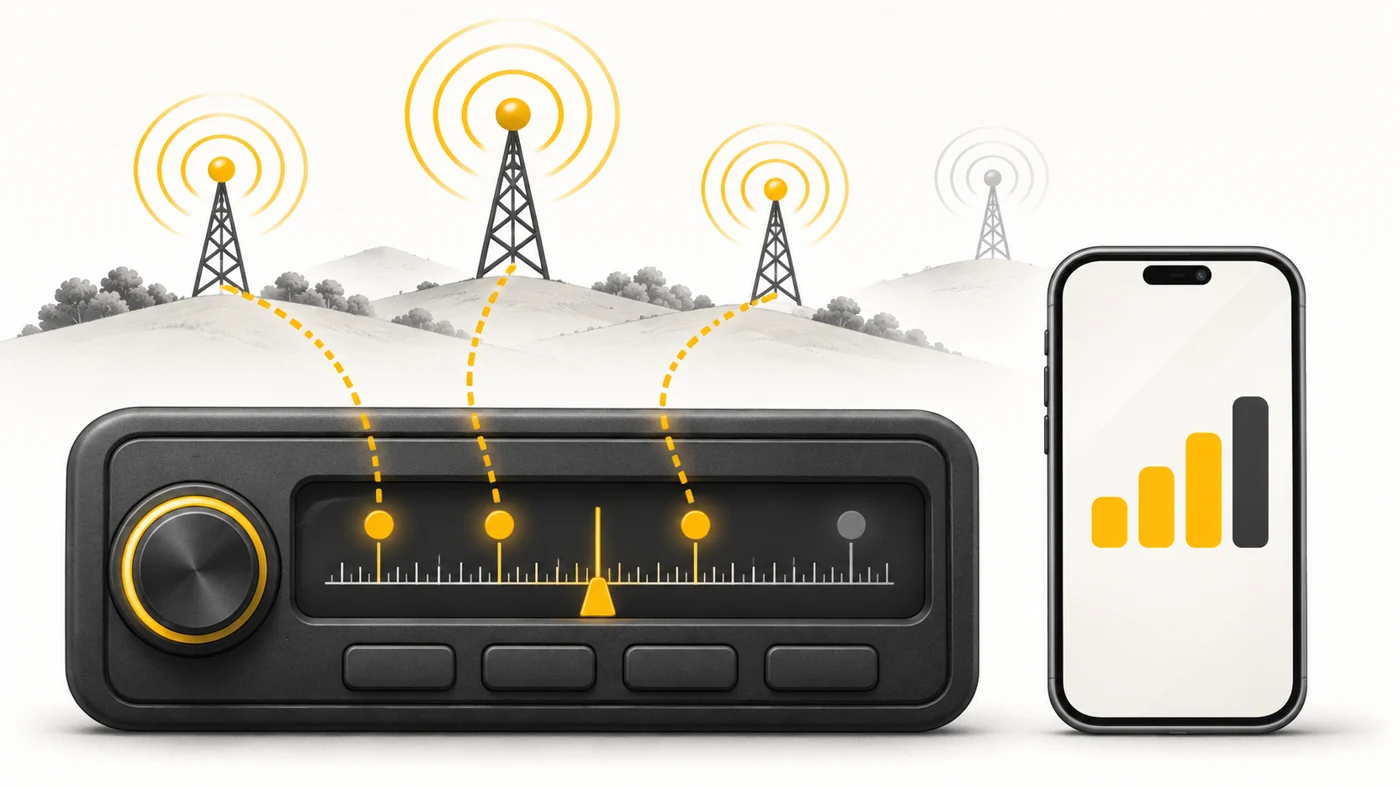
Think of a car radio: if your favourite station is at 101.5 and the radio only tunes up to 100, you will not hear it. Mobile networks are similar, except there are dozens of "stations", and operators in each country use their own set. A phone made for another market may miss some of the "stations" in your country.
How it works
- Each country assigns specific frequency bands to operators.
- Operators use several bands: lower ones for coverage, higher ones for speed.
- The phone's modem supports a set list of bands that depends on the market version.
- If your band is not supported, the phone falls back to another band or to 3G/2G.
- Carrier aggregation combines several bands for higher speeds.

Where you'll see it
The band list is in the phone's full specs (often on the manufacturer's website or in specialist databases). In Europe, common LTE bands include 1, 3, 7, 8 and 20, and n78 is the main 5G band. Check your operator's website for its exact list. Be especially careful with phone versions made for other regions.
Does it matter when buying
A lot, if you buy a phone abroad or a grey-import version. I recommend comparing the phone's band list with your operator's. Missing a low band such as band 8 (900 MHz) or band 20 (800 MHz), for example, can weaken coverage outside cities and inside buildings.
Myths
- Myth: If a phone supports 4G, it works on 4G anywhere. Reality: Only if the bands match.
- Myth: A global version always has every band. Reality: Even "global" versions differ, so check the list.
FAQ
How do I find my phone's bands?
In the full specs on the manufacturer's website or in phone databases.
Why is signal worse outside the city?
Lower bands are used there, which your phone may not support, and towers are farther apart.
What is n78?
A 5G band at 3.5 GHz, the main one for 5G in Europe.