
Degrees of freedom (DoF): what "6 axes" means for a robot
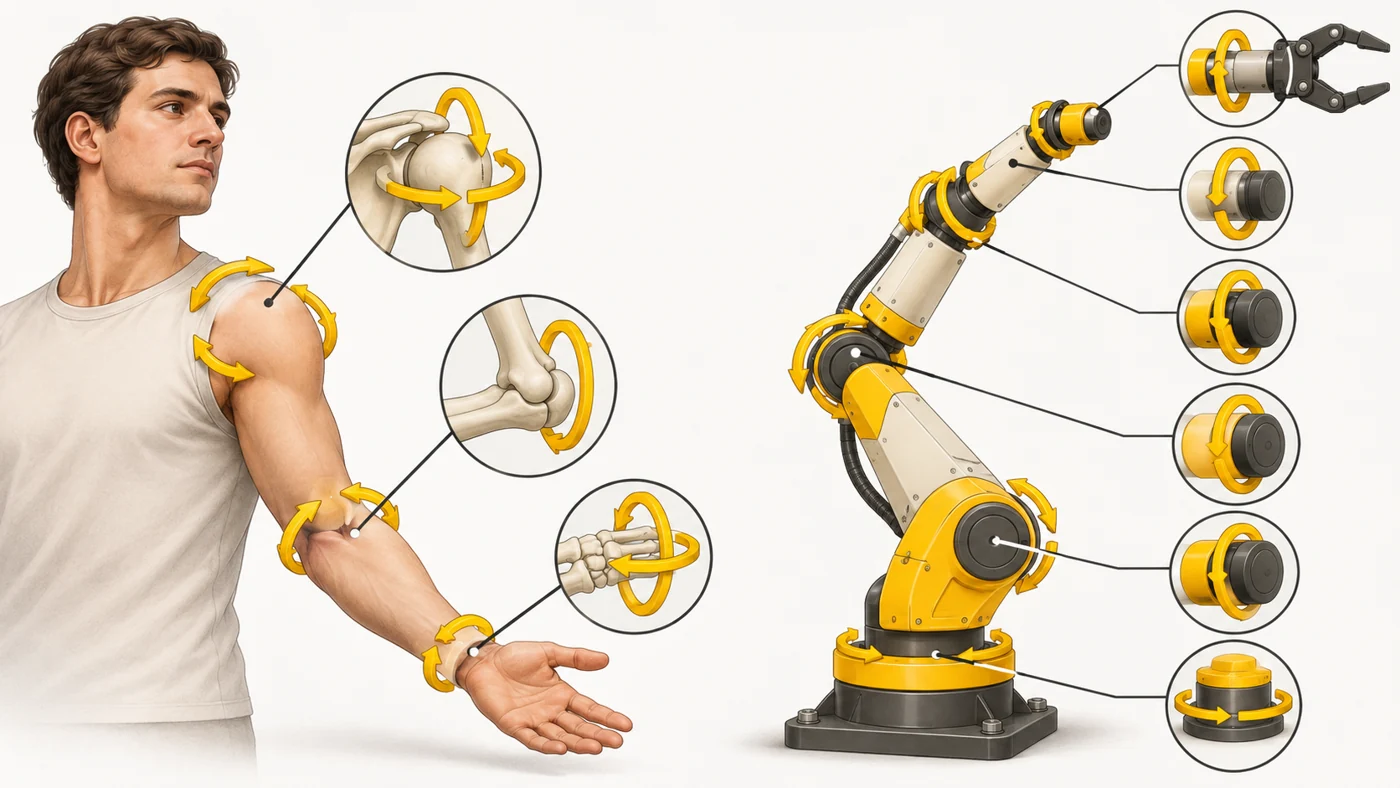
Degrees of freedom (DoF) are the number of independent ways a mechanism can move: each joint or axis that rotates or slides on its own adds one degree.
In plain words
Rest your elbow on a table and move only your hand: up and down, left and right, twist it. That is already three degrees of freedom in your wrist. Now add the elbow and shoulder, and your arm can reach any point in front of you. The more independent movements, the more agile the mechanism.
How it works
- Each rotating joint of a robot gives one degree of freedom.
- Linear movements (extending, lifting) are degrees of freedom too.
- To place a tool at any point in space at any angle, you need at least 6 degrees.
- A seventh degree gives "spare" flexibility - like a human elbow that can move around an obstacle.
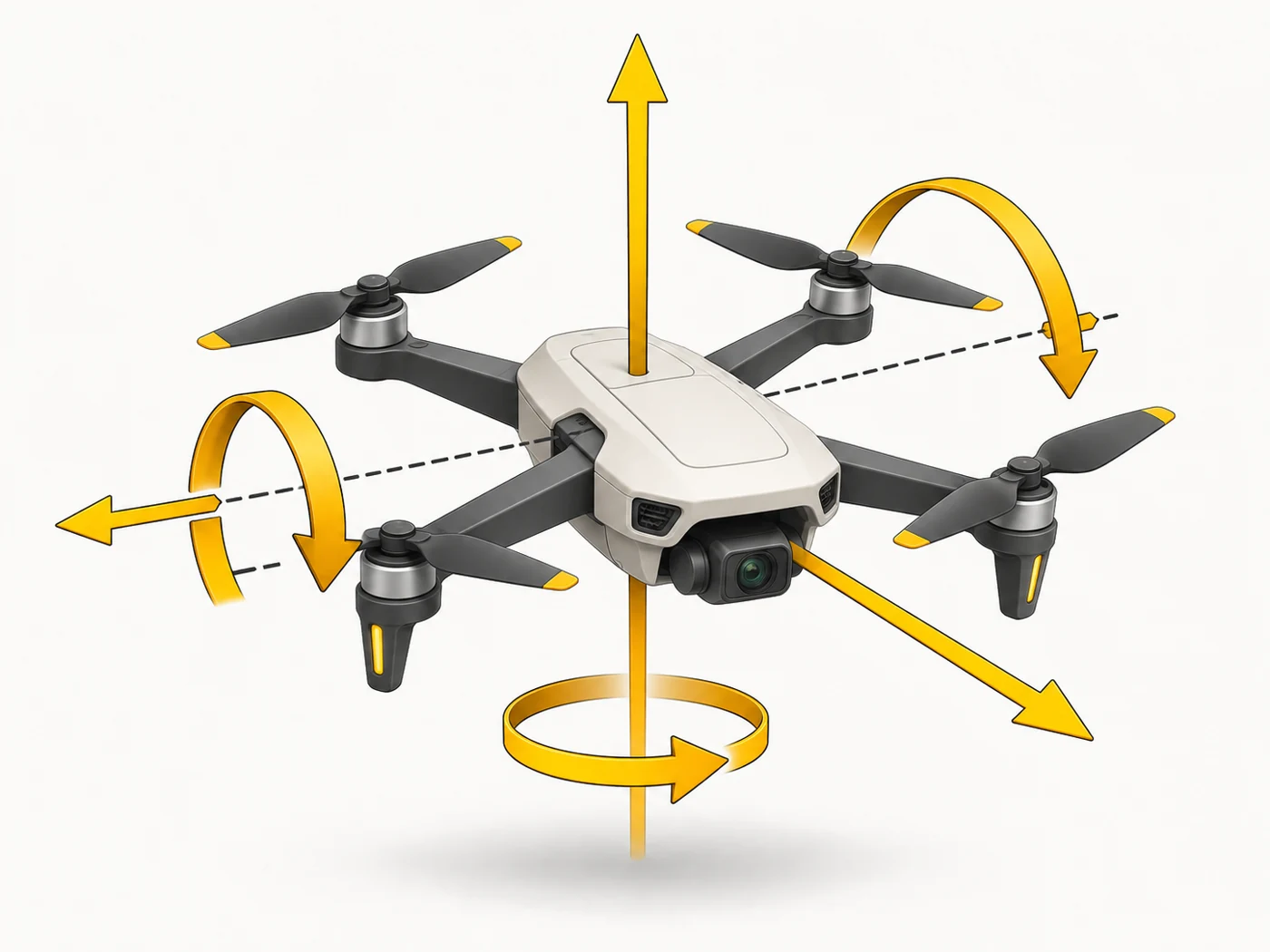
- A rigid body in space (a drone, a phone) has 6 degrees: 3 for moving and 3 for rotating.
Where you'll see it
In the specs of industrial robots (6-axis arm), humanoids (dozens of degrees of freedom, many in the hands), VR headsets ("6DoF" - tracking both head rotation and movement), drones and gimbal stabilisers (3-axis).
Does it matter when buying
When choosing a VR headset, 6DoF is a must: you can walk and lean in a game, not just turn your head. For a smartphone gimbal, 3 axes is standard. And in news about humanoids, the number of degrees of freedom in the hand is a good sign of how nimble its fingers are.
Myths
- Myth: More degrees of freedom is always better. Reality: Each one adds weight, cost and control complexity.
- Myth: DoF is the number of motors. Reality: Usually, yes, but one motor can drive several linked movements, and vice versa.
FAQ
How many degrees of freedom does a human arm have?
From shoulder to wrist about 7, and with the fingers more than 20.
What does 6DoF mean in VR?
The headset tracks both head rotation and movement through space.
How many axes does a smartphone gimbal have?
Most often 3: tilt, pan and roll.
Related terms
Robotic arm, Robot kinematics, Humanoid robot, Inertial measurement unit (IMU)