
Periscope camera: how a smartphone gets 5x optical zoom and more
A periscope telephoto is a smartphone camera in which a prism or mirror turns the light 90° so it travels along the body. This lets a long lens for 3x-10x optical zoom fit inside a thin phone.
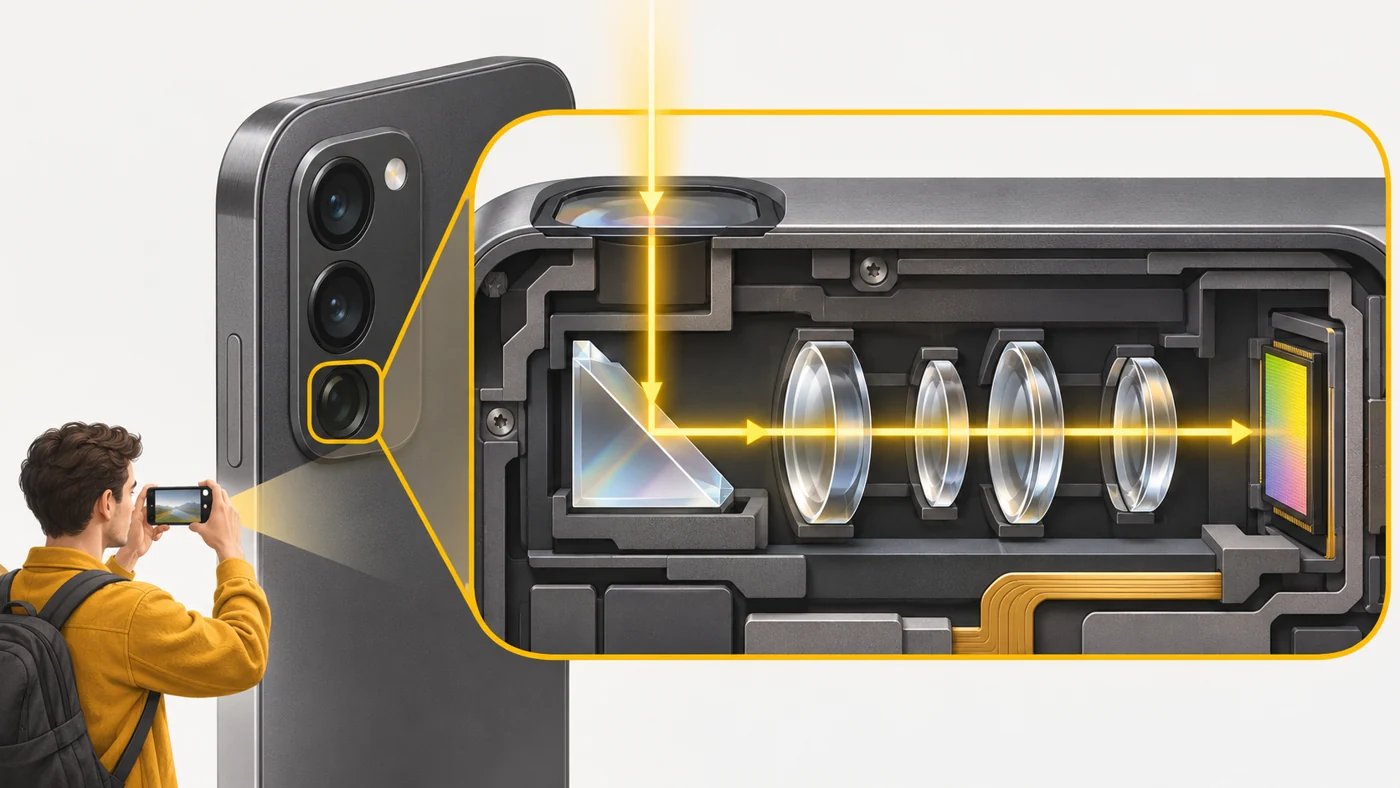
In plain words
Remember a submarine periscope? Light comes in at the top, bounces off a mirror and travels down a tube to your eyes. A periscope camera is the same, only it "lies" inside the phone. Strong zoom needs a long "tube", but the phone is thin, so the tube is laid sideways.
How it works
- Light enters the camera window on the back.
- A prism or mirror turns it 90° along the body.
- A long lens assembly gives a long focal length - optical magnification.
- The sensor stands upright at the end of this "tunnel".
- Optical stabilisation is often added, because every hand tremor shows when zoomed in.

Where you'll see it
In flagship and many upper-mid-range smartphones: "5x periscope", "3.5x periscope telephoto". You can see it as a rectangular window in the camera module. In our smartphone comparisons it appears in the camera row.
Does it matter when buying
If you photograph concerts, animals, architecture or portraits from a distance, yes - optical zoom is dramatically better than digital. For selfies and landscapes it is not critical. Look at the zoom factor and the telephoto sensor size: a periscope with a big sensor also shoots well at night.
Myths
- Myth: 100x zoom is optical zoom. Reality: Optical zoom is usually 3-10x; beyond that it is digital and hybrid zoom with processing.
- Myth: Any third camera is a telephoto. Reality: Often the third camera is a macro lens or a depth sensor.
FAQ
How is optical zoom different from digital?
Optical zoom magnifies with lenses without losing quality; digital zoom crops and enlarges the image.
Can I shoot portraits with a periscope?
Yes, and often better than with the main camera: less facial distortion.
Why is periscope night shooting sometimes poor?
Because of a smaller sensor and a darker aperture than the main camera.
Related terms
Optical zoom, Equivalent focal length, Optical image stabilisation (OIS), Camera sensor size