
Satellite internet (Starlink): how it works and who needs it
Satellite internet is internet access via satellites in orbit. Modern low-Earth-orbit systems (Starlink, OneWeb and others) have thousands of satellites and deliver speeds and latency close to terrestrial internet through a compact antenna terminal.
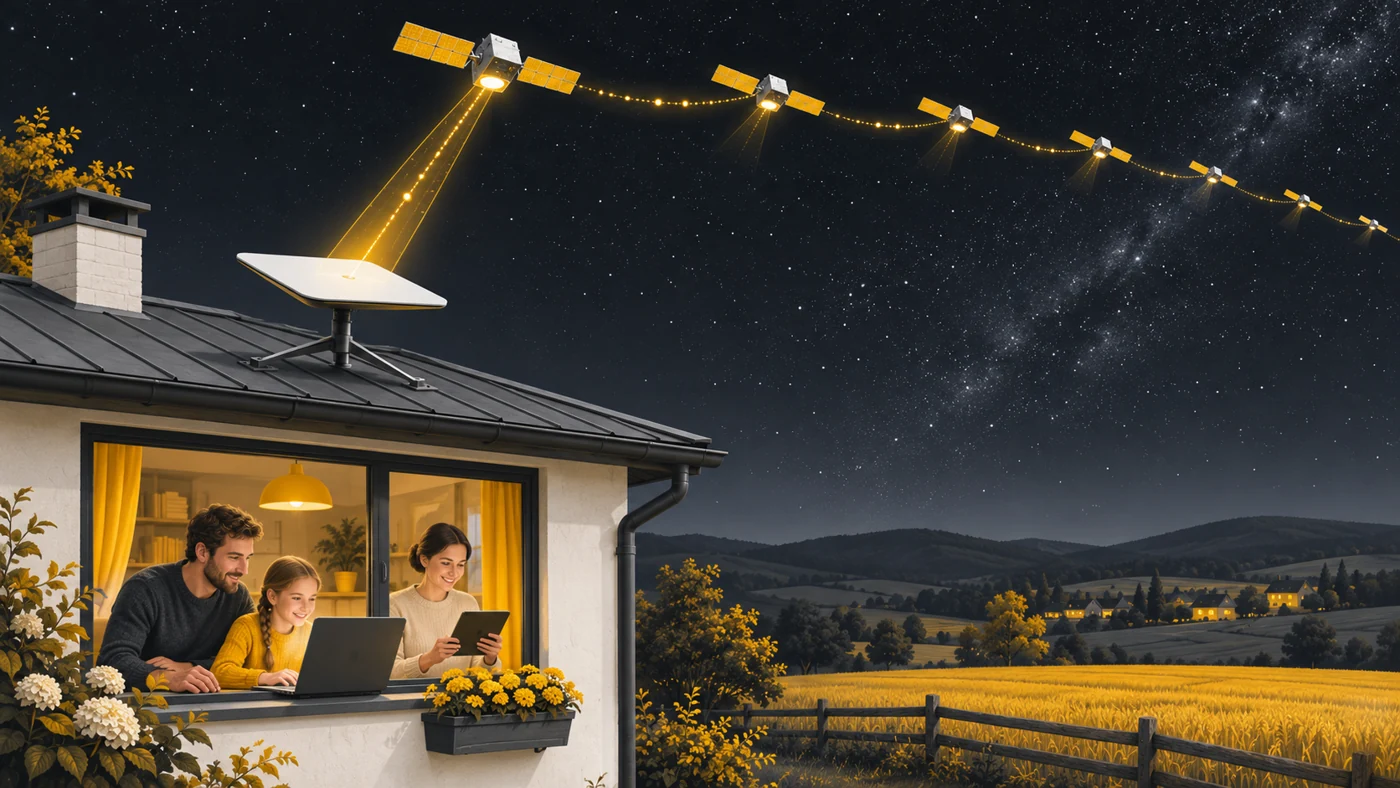
In plain words
Regular internet travels through underground cables or from a tower a few kilometres away. Satellite internet is like a relay race in the sky: the antenna on your roof passes data to a satellite flying overhead, which passes it to a ground station. Old satellites hung very high, so the "relay" took a long time. New ones fly low, and there are thousands of them - so it is fast.
How it works
- The antenna terminal on the roof or in the yard finds satellites automatically.
- Low-orbit satellites pass overhead within minutes, and the terminal switches between them.
- The satellite relays data to a ground station connected to the internet, or to other satellites by laser.
- The terminal connects to its own router or to yours by cable.
- It needs a clear view of the sky - trees and buildings degrade the connection.

Where you'll see it
Systems like Starlink are widely used in remote villages, at infrastructure sites, in shelters and medical facilities, and as backup internet during power outages. They are also used on ships, aircraft and expeditions.
Does it matter when buying
If you have no fibre or stable mobile coverage, or need a reliable backup connection, yes. Before buying, consider: you need power (the terminal draws noticeable wattage, so during outages you need a power bank or power station with enough capacity), a spot with a clear sky and a monthly subscription.
Myths
- Myth: Satellite internet is always slow with high latency. Reality: That applies to old geostationary systems. Low-orbit ones offer latency suitable for video calls and gaming.
- Myth: The terminal works in a flat by the window. Reality: It needs as open a view of the sky as possible - ideally on the roof.
FAQ
How much power does the terminal use?
It depends on the model - from a few dozen to over a hundred watts.
Can I connect my own router?
Yes, through an Ethernet adapter or bridge mode.
Does it work in the rain?
Yes, but heavy downpours or snow on the antenna can reduce speed.
Related terms
4G/5G router, Satellite messaging on smartphones, mAh and Wh, WAN and LAN