
LTE: the technology behind 4G internet
LTE (Long Term Evolution) is the mobile standard that delivers 4G internet. Its enhanced versions - LTE-Advanced and LTE-Advanced Pro - add carrier aggregation and more antennas for higher speeds.

In plain words
The older 3G networks were like old roads with narrow lanes and traffic lights for voice. LTE was built from scratch as a high-speed motorway for data only: everything, even voice, travels as internet packets. That is why pages load quickly and video does not "freeze".
How it works
- The phone connects to an LTE base station on one of the frequency bands.
- OFDMA technology shares the channel among many users.
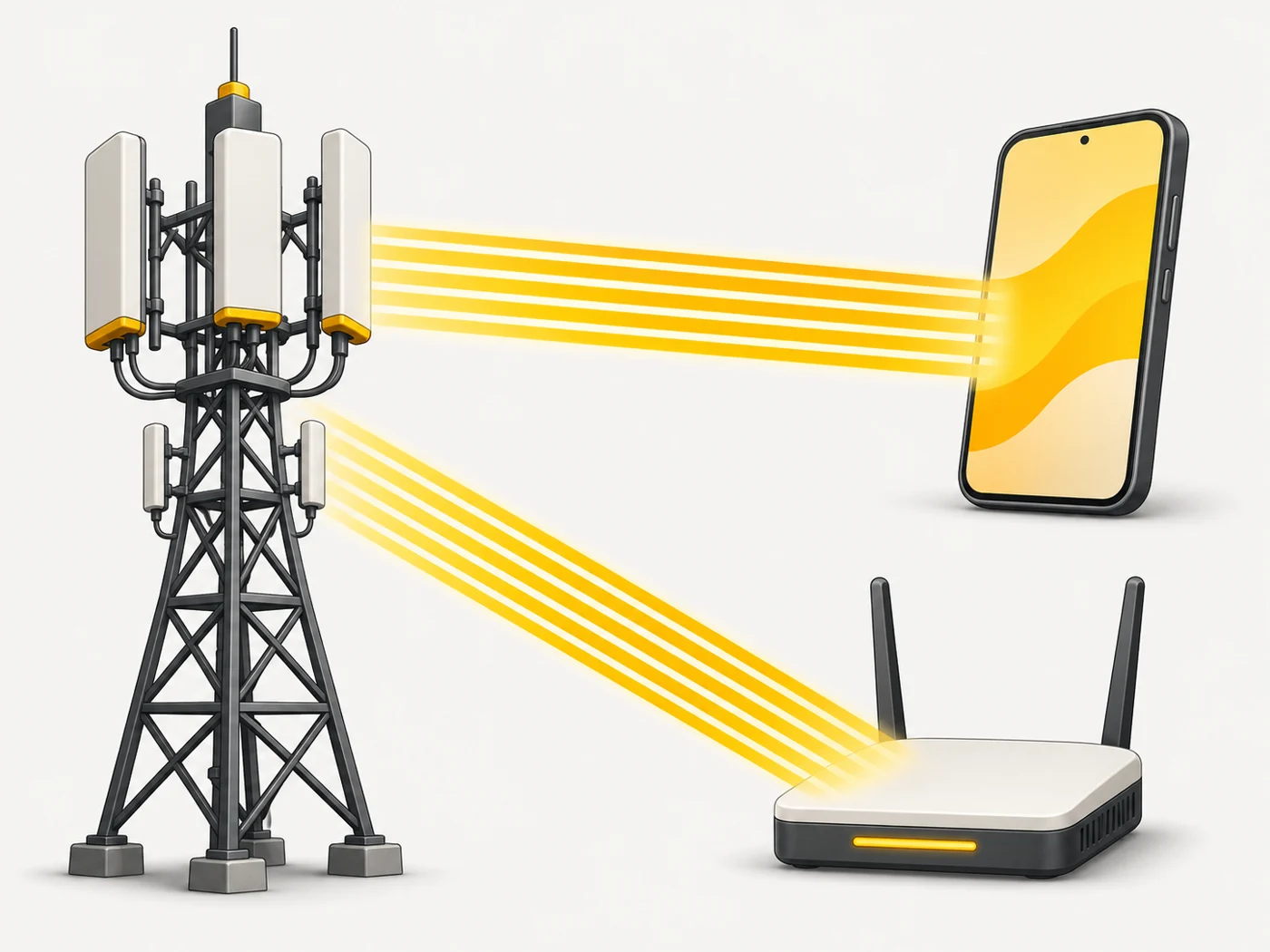
- Multiple antennas (MIMO) send several streams at once.
- LTE-Advanced combines several bands - hence the 4G+ icon.
- Voice is carried via VoLTE or temporarily switches to 3G/2G.
Where you'll see it
The LTE or 4G icon in your phone's status bar. In specs: "4G LTE", "LTE Cat. 18" and a list of bands. LTE is also found in 4G routers, watches with eSIM, cars and industrial sensors.
Does it matter when buying
Every modern phone has LTE; what matters more is whether it supports the right bands and aggregation. The LTE category (Cat) shows the modem's maximum speed - especially important for routers at a country house.
Myths
- Myth: LTE is only for data; you cannot make calls over it. Reality: With VoLTE, calls go over LTE with better quality.
- Myth: The LTE category is a phone's most important spec. Reality: Real speed depends on the tower, signal and your plan.
FAQ
What are LTE Cat. 6 and Cat. 18?
Modem categories: the higher the number, the higher the maximum speed.
How is LTE different from 4G?
LTE is the technology, 4G the generation; in everyday use they are synonyms.
What are LTE-M and NB-IoT?
Low-power versions for smart meters and sensors.
Related terms
4G, 5G, Cellular bands, Carrier aggregation, VoLTE and VoWiFi