
MU-MIMO: how a router talks to several devices at once
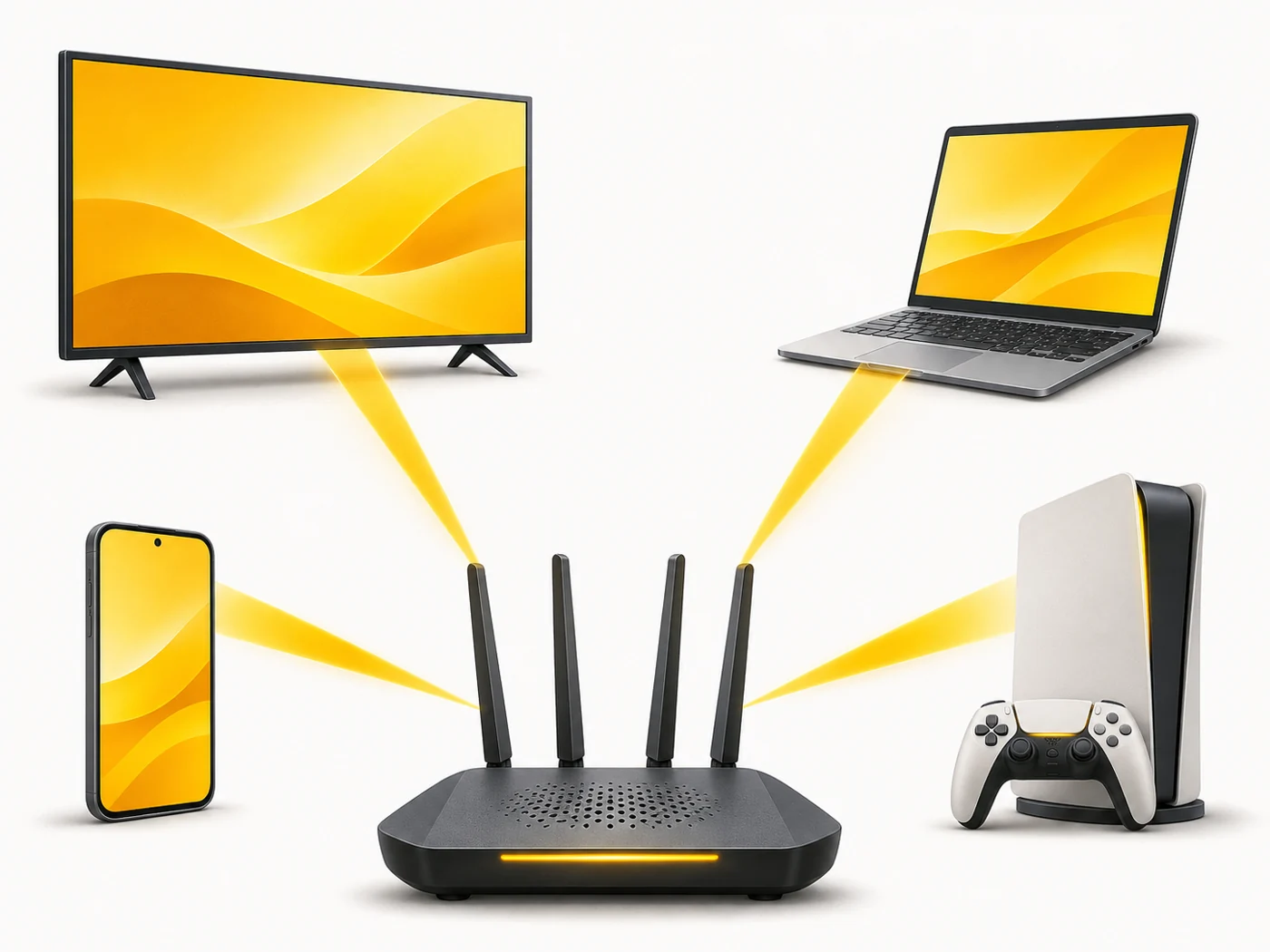
MU-MIMO (Multi-User Multiple Input Multiple Output) is a technology in which a router with several antennas sends separate data streams to different devices at the same time instead of serving them one by one.

In plain words
Imagine a teacher answering students' questions one at a time - while one talks, the others wait. MU-MIMO is like having several teachers in the classroom at once, each answering their own student. The more "teachers" (antenna streams) a router has, the more students it can serve in parallel.
How it works
- The router has several antennas and radio chains - labelled 2×2, 4×4.
- Each chain can form a separate spatial data stream.
- The router "aims" different streams at different devices (using beamforming).
- Devices receive data at the same time rather than in turn.
- In Wi-Fi 6 and 7, MU-MIMO works for both download and upload.
Where you'll see it
In router specs: "MU-MIMO", "4×4 MU-MIMO", "4 streams". Mostly in mid-range and higher routers. Smartphones usually have 2×2 - that is, two streams.
Does it matter when buying
In a home with several active devices it helps, especially when one person streams 4K while another plays games. But do not chase "8 streams": with only a few devices you will not feel the difference. I treat MU-MIMO as a sign of a quality router, not its main spec.
Myths
- Myth: More antennas always means faster internet. Reality: Antennas improve coverage and parallelism, not your plan.
- Myth: MU-MIMO and MIMO are the same. Reality: MIMO is several streams to one device; MU-MIMO is to several devices at once.
FAQ
What does 2×2 mean?
Two transmit and two receive chains - two data streams.
Does my phone support MU-MIMO?
Most modern phones with Wi-Fi 5 or newer do.
Do I need external antennas for MU-MIMO?
No, internal ones work too; the number of streams matters more than how the antennas look.