
VPN on a router: what it is for and how it works at home
A VPN (virtual private network) on a router creates an encrypted tunnel over the internet. The router can be a VPN server (you connect to your home network from anywhere) or a VPN client (all your home traffic goes through a VPN service). Popular protocols are WireGuard, OpenVPN and IPSec.

In plain words
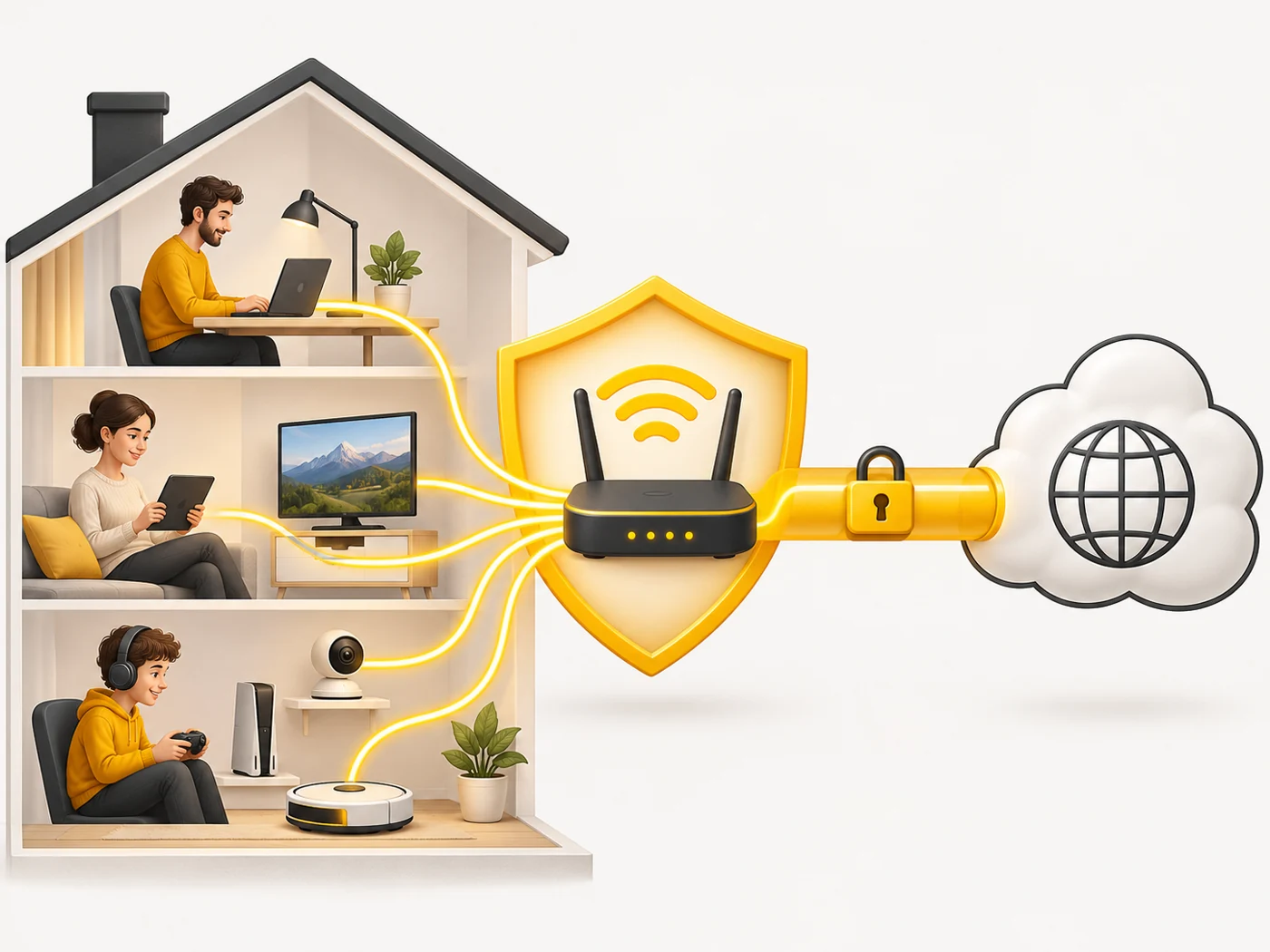
The internet is like a big city with crowded streets. A VPN is like an underground tunnel between two houses: nobody on the street can see what you are carrying. If the router is a VPN server, you walk through the tunnel from a café in another city straight home, to your cameras and storage. If the router is a VPN client, the whole household goes into town through the tunnel.
How it works
- A VPN server on the router waits for connections from outside.
- Your phone or laptop sets up an encrypted connection to it.
- You end up "inside" your home network, as if you were at home.
- In client mode, the router itself connects to a VPN service and encrypts traffic for all devices.
- WireGuard is a modern, fast and simple protocol; OpenVPN is older and very widespread.
Where you'll see it
VPN server and client modes are supported by many routers from ASUS, TP-Link, Keenetic, MikroTik, GL.iNet and others. In our router comparisons it is the VPN row. Running a server often requires a public IP address from your provider or a DDNS service.
Does it matter when buying
It is useful if you want to reach your home cameras, storage or smart home without cloud services, or to protect your connection while travelling (with a travel router). For ordinary browsing, a router VPN is not essential. Remember that encryption loads the router's processor - VPN speed is often lower than your plan.
Myths
- Myth: A VPN makes you completely anonymous. Reality: It hides your traffic from your provider and neighbours, but the VPN service and websites can still see other data.
- Myth: Any router with VPN gives full speed. Reality: VPN speed depends on the router's processor and the protocol.
FAQ
Which is better - WireGuard or OpenVPN?
WireGuard is usually faster and simpler; OpenVPN is compatible with most older systems.
Why do I need a public IP address?
So the router can be reached from outside. Without one, DDNS services or the manufacturer's cloud solutions help.
Is using a VPN legal?
In most countries, yes, though some restrict it. What matters is what you use it for.
Related terms
Travel router, WAN and LAN, WPA3, PPPoE, IPoE and DHCP