
Wi-Fi channel width (20, 80, 160, 320 MHz): what it is and what it affects
Wi-Fi channel width is the band of frequencies the router uses to send data: 20, 40, 80, 160 or 320 MHz. A wider channel carries more data at once but is more sensitive to interference.
In plain words
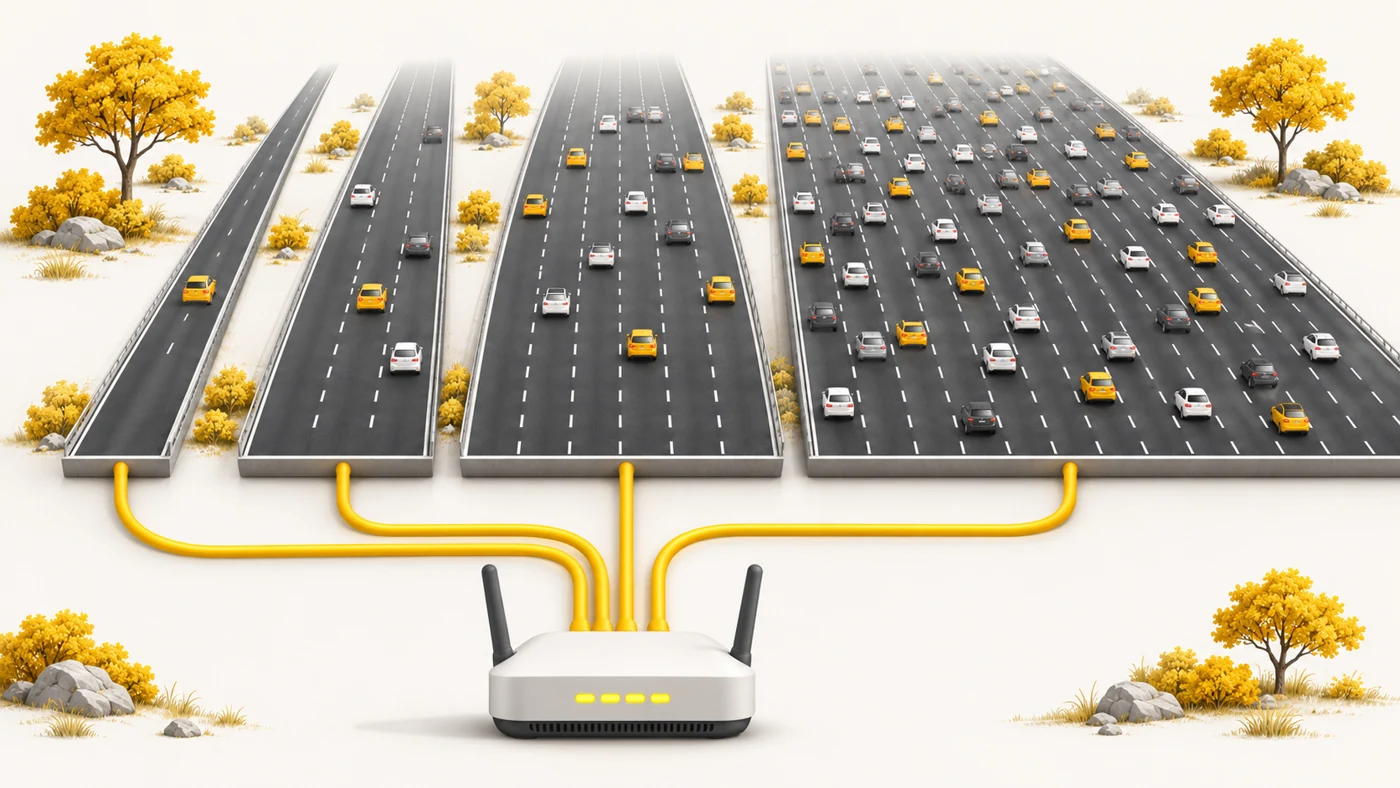
A Wi-Fi channel is like a road. 20 MHz is one lane, 80 MHz four, 160 eight and 320 sixteen. A wide road carries more cars, but in a crowded city (an apartment block with dozens of neighbouring networks) it is hard to find one that is free - you have to share it.
How it works
- A band (for example, 5 GHz) is divided into 20 MHz channels.
- The router can combine several adjacent channels into a wider one.
- The wider the channel, the higher the maximum speed.
- But a wide channel overlaps more easily with neighbouring networks and interference.
- Wi-Fi 6 supports up to 160 MHz, Wi-Fi 7 up to 320 MHz (only on 6 GHz).

Where you'll see it
In router specs: "160 MHz", "320 MHz". You can set the channel width manually in the router settings. In our router comparisons, width affects the Wi-Fi speed row.
Does it matter when buying
Yes, because real-world speed depends on it. Budget Wi-Fi 6 routers without 160 MHz are noticeably slower. But in an apartment block full of networks I sometimes suggest dropping to 80 MHz - stability improves. For 320 MHz you need both a router and a device with Wi-Fi 7 on 6 GHz.
Myths
- Myth: Always set the maximum width. Reality: On busy airwaves a narrower channel is often more stable.
- Myth: Every Wi-Fi 7 router has 320 MHz. Reality: Only models with the 6 GHz band.
FAQ
What width should I use on 2.4 GHz?
Usually 20 MHz - there is little room and lots of interference.
Why can my phone not see 160 MHz?
It may not support that width - check the specs.
Does width affect range?
A wide channel often performs worse at the edge of coverage.
Related terms
Wi-Fi 7, 2.4, 5 and 6 GHz bands, Wi-Fi 6 and 6E, Wi-Fi speed ratings (AX3000, BE5000)