
AX3000, BE5000: what the numbers on a router box mean
Labels such as AX1800, AX3000, BE3600 and BE19000 are a router's speed class. The letters show the generation (AC for Wi-Fi 5, AX for Wi-Fi 6, BE for Wi-Fi 7), and the number is the combined theoretical speed of all bands in Mbps.

In plain words
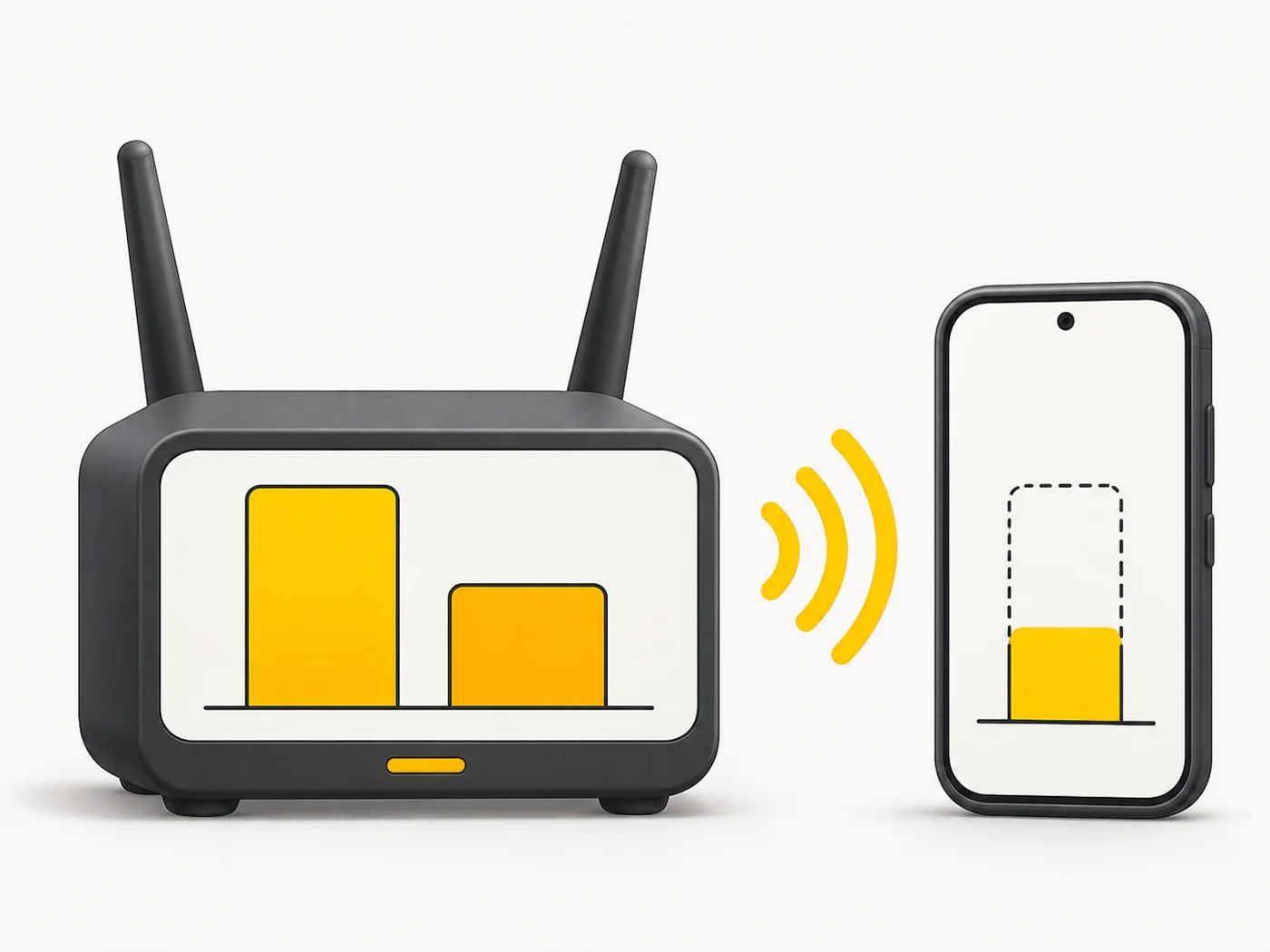
Imagine a house with three taps, and the box says "3000 litres per minute" - the total of all taps together at full pressure. But you wash your hands at one tap and get only its share. Routers are the same: AX3000 is, for example, 574 Mbps on 2.4 GHz plus 2402 on 5 GHz, and your phone gets part of one of them.
How it works
- The maximum speed of each band is calculated under lab conditions.
- For example, AX3000 = 574 (2.4 GHz) + 2402 (5 GHz) Mbps.
- The numbers depend on the number of streams, channel width and encoding.
- A device connects to one band (or several via MLO in Wi-Fi 7).
- Real speed is usually several times lower than the number on the box.
Where you'll see it
On the boxes and in the specs of routers, mesh systems and extenders. In our router comparisons these are the Wi-Fi row (class) and the Wi-Fi speed row (per-band breakdown).
Does it matter when buying
Yes, as a guide to the class. For a flat with a plan of up to 1 Gbps, I recommend AX3000 or BE3600 and above. But look at the breakdown, not just the total: 5 GHz speed matters more than 2.4. And remember: two routers with the same number can differ in coverage quality.
Myths
- Myth: My phone will get the speed on the box. Reality: No, it is the sum of the bands under lab conditions.
- Myth: A bigger number always means a better router. Reality: The processor, antennas, firmware and ports matter too.
FAQ
Which is better: AX3000 or BE3600?
BE3600 is Wi-Fi 7 with MLO; all else being equal, it is newer and more future-proof.
Where does the number 3000 come from?
It is the rounded sum of the bands' maximum speeds.
What real speed should I expect?
Usually a third to a half of one band's maximum when close to the router.
Related terms
Wi-Fi 7, Wi-Fi 6 and 6E, Wi-Fi channel width, 2.4, 5 and 6 GHz bands