
Active matrix: how a screen controls each pixel individually
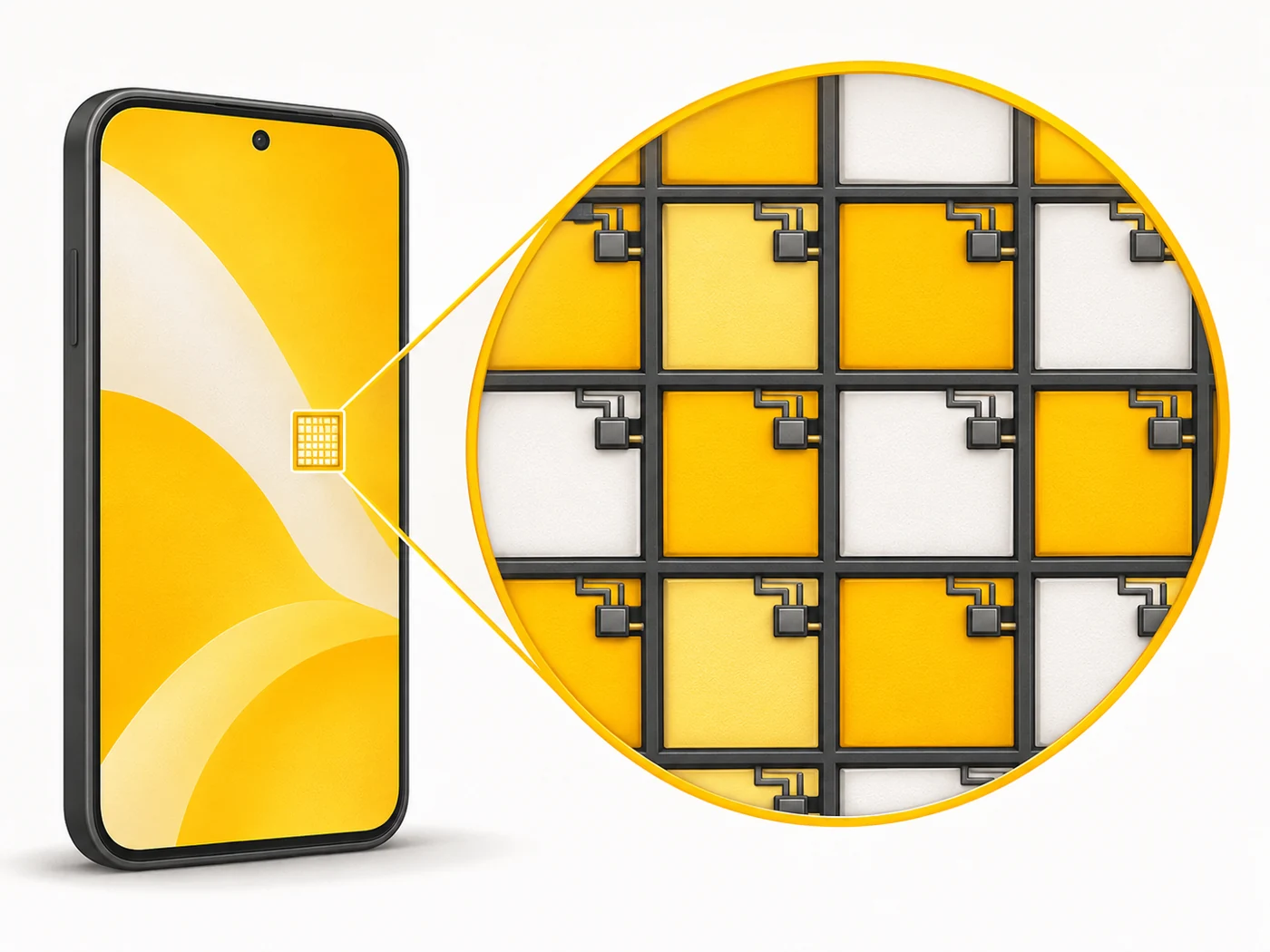
Active matrix is a screen-driving scheme in which each pixel has its own transistor (and capacitor) that holds its state until the next refresh. The "AM" in AMOLED stands for active matrix. Almost all modern screens use an active matrix.

In plain words
A passive matrix is like a teacher going along each row of pupils in turn and telling them something: by the time they reach the last row, the first has forgotten. An active matrix is when each pupil has an assistant who remembers the task and holds it while the teacher goes round the class. That is why the picture is stable and fast.
How it works
- The screen is a grid of rows and columns.
- Each pixel has a thin-film transistor (TFT).
- The controller refreshes the rows one after another.
- The transistor and capacitor hold the pixel's state between refreshes.
- This gives high resolution, speed and contrast.
Where you'll see it
Active matrix is used in all modern LCDs (TFT, IPS) and OLED screens (AMOLED). Passive matrix (PMOLED, STN) is found only in simple small displays - for example, in cheap fitness bands and gadgets.
Does it matter when buying
It is not critical for choosing, since almost all screens are active. But it explains where the "AM" in AMOLED comes from and why old passive displays were dim and slow.
Myths
- Myth: AMOLED is a separate technology from OLED. Reality: It is OLED with an active matrix.
- Myth: Passive matrix is no longer used. Reality: It is still used in simple small displays.
FAQ
What is PMOLED?
OLED with a passive matrix - for small, simple screens.
Why is active matrix better?
A more stable picture, higher resolution and speed.
Does E Ink use an active matrix?
Yes, modern E Ink screens use an active matrix too.